Séance 12 - Sociologie du numérique – Mise en scène de soi, réseaux sociaux et culture participative
Introduction
Structure de la présentation
- La sociologie de l'action de Pierre Bourdieu
- L'analyse structurale des réseaux sociaux
- L'interactionnisme symbolique d'Erving Goffman
La sociologie de l'action de Pierre Bourdieu
[Bourdieu's] influence on social science research is evident not only in these areas [(political sociology, education and cultural stratification)], which he studied intensively and wrote about extensively, but also in at least one area which he never touched upon at all, namely, digital communication technologies. Over the past 15–20 years, even before his death in 2002, Bourdieu’s development of the interrelated concepts of field, capital, and habitus has informed what is increasingly termed ‘digital sociology’.
La sociologie de l'action de Pierre Bourdieu - 2
[L]e style de vie des classes supérieures se caractérise moins par la légitimité culturelle des préférences et des habitudes que par l’éclectisme des goûts et des pratiques.
La sociologie de l'action de Pierre Bourdieu - 3 - Le chaîne de la consécration littéraire
- Le salon ou la revue supportent l'émergence
- La critique apporte la reconnaissance
- L'académie engage, par ses prix ou ses cooptations, la consécration
- L'école, avec ses programmes et ses manuels, intègre définitivement à l'institution et garantit la conservation
L'analyse structurale des réseaux sociaux
Each player has a network of contacts in the arena. Something about the structure of the player's network and the location of the player's contacts in the social structure of the arena provides a competitive advantage in getting higher rates of return on investments.
L'analyse structurale des réseaux sociaux - 2 - Liens faibles
Intuitively speaking, this means that whatever is to be diffused can reach a larger number of people, and traverse greater social distance […] when passed through weak ties rather than strong. If one tells a rumor to all his close friends, and they do likewise, many will hear the rumor a second and third time, since those linked by strong ties tend to share friends. If the motivation to spread the rumor is dampened a bit on each wave of retelling, then the rumor moving through strong ties is much more likely to be limited to a few cliques than that going via weak ones; bridges will not be crossed.
L'analyse structurale des réseaux sociaux - 3 - Clique
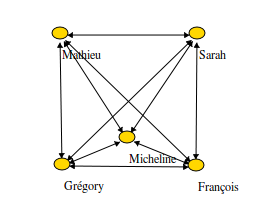
L'analyse structurale des réseaux sociaux - 4 - Trous structuraux

L'analyse structurale des réseaux sociaux - 5

L'analyse structurale des réseaux sociaux - 6
Nous ne souhaitons pas ici appliquer telle quelle l’analyse structurale de réseau à la littérature, mais entendons plutôt utiliser, dans le cadre d’une démarche littéraire, et de façon exploratoire et heuristique, les notions mises au point par celle-ci. Nous croyons en effet que ce modèle théorique permettra de découvrir des phénomènes socio-littéraires nouveaux ou de donner de meilleures explications à des faits connus mais qui défient encore l’analyse. Plus précisément, nous estimons qu’il jette une lumière nouvelle et fort utile sur tout un pan de la vie littéraire, celui des relations intersubjectives.
L'interactionisme symbolique d'Erving Goffman
L'interactionisme symbolique d'Erving Goffman - 2

L'interactionisme symbolique d'Erving Goffman - 3
In this context, the online environment could be seen as a stage with the offline life as the backstage, and these particular actors strongly invest in their costume – wishing to provoke the desired reaction from other SL inhabitants. Avatars are then subject to transformed social interaction. This phenomenon means that, with the advent of avatars, users have been able to emphasize and minimize certain aspects of self, such as appearance or behaviour. This has become possible because users are now editors and creators – designing and creating their self-representations, choosing what to bring to the foreground or hide in the background.
L'interactionisme symbolique d'Erving Goffman - 4
To reduce stigma and avoid discriminatory behavior, a stigmatized person is therefore likely to devise a variety of coping methods. One such method would be to seek for sympathetic others or their own—people who share their stigma. The online environment invites the own to escape their isolation in the physical realm and offers them support from similar others. The own, knowing from personal experiences what it is like to have a particular stigma, can provide the individual with tools relevant to their shared condition in the form of tricks of the trade, and with a circle of lament to which they can withdraw for moral support and acceptance.