Enjeux et débats des humanités numériques
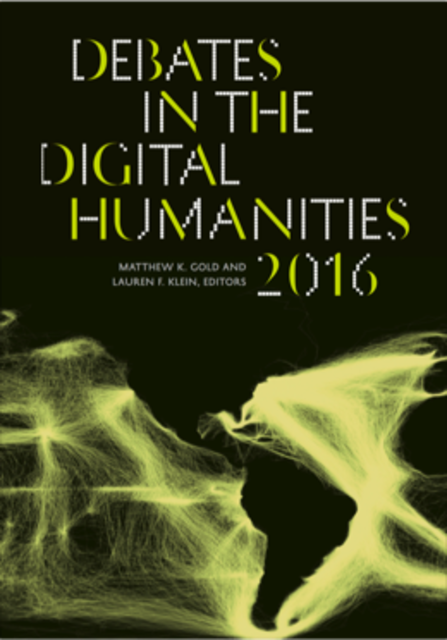
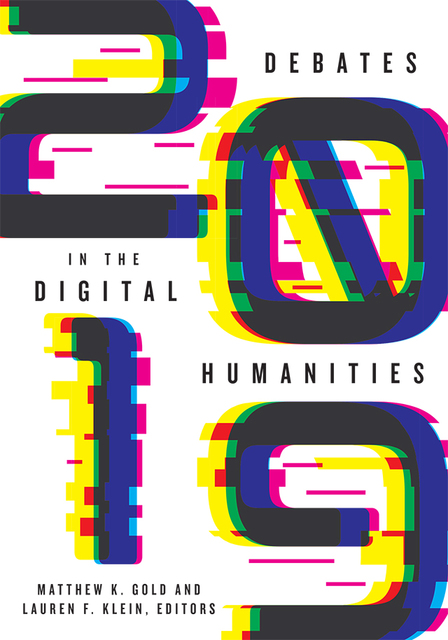
Debates in the Digital Humanities

Enjeux
- Enjeux épistémologiques
- Le réductionnisme des méthodes computationnelles
- Absence - supposée - de résultats
- Arbitraire théorique et manque de rigueur
- Enjeux politiques
- Néo-libéralisme et humanités numériques
- #TransformDH
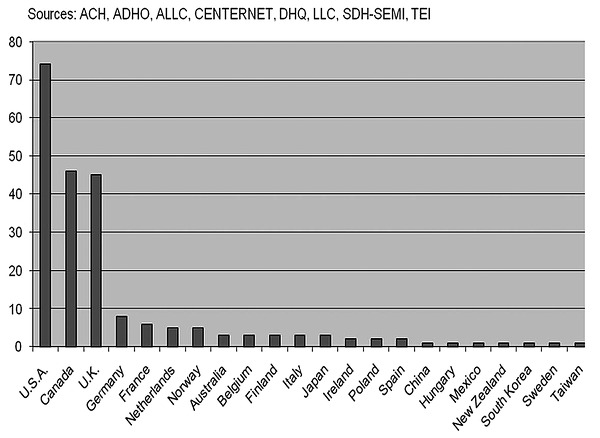
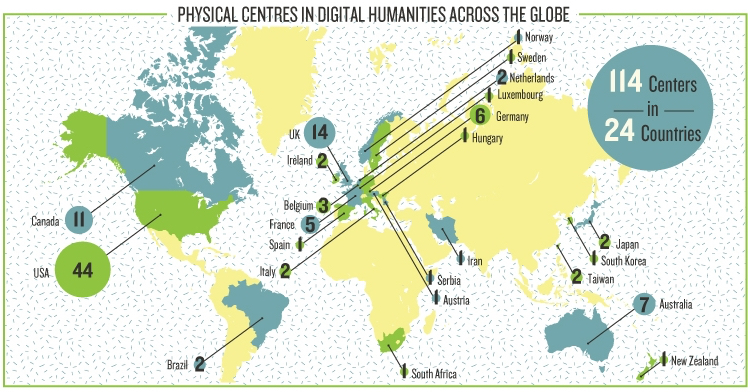
- Hégémonie anglo-saxonne
Enjeux épistémologiques
Stephen Marche, « Literature is not Data: Against Digital Humanities »
Adam Kirsch, « Technology is Taking Over English Departments » (1)
Humanistic thinking does not proceed by experiments that yield results; it is a matter of mental experiences, provoked by works of art and history, that expand the range of one’s understanding and sympathy. It makes no sense to accelerate the work of thinking by delegating it to a computer when it is precisely the experience of thought that constitutes the substance of a humanistic education. The humanities cannot take place in seconds.
Timothy Brennan, « The Digital Humanities Bust » (1)
Distant readers are not wrong to say that no human being can possibly read the 3,346 novels that Matthew L. Jocker […] has machines do in Macroanalysis: Digital Methods and Literary History. But they never really say why they think computers can. Compared with the brute optical scanning of distant reading, human reading is symphonic -- a mixture of subliminal speaking, note-taking, savoring, and associating. Computer circuits may be lightning-fast, but they preclude random redirections of inquiry. By design, digital "reading" obviates the natural intelligence of the brain making leaps, establishing forms of value, and rushing instinctively to where it means to go. Scour DH literature all you want, but you will find no head-on. treatment of the theoretical problems that such methods entail. DH offers us powerful but dull tools, like a weightlifter doing a pirouette.
Timothy Brennan, « The Digital Humanities Bust » (2)
Ted Underwood, the Illinois professor, finds "interesting things" when tracing word frequencies in stories but does not say what they are -- a typical gesture in DH literature. Similarly, Alexander Galloway, a professor of media, culture, and communication at New York University, accepts that word frequencies in Melville are significant: "If you count words in Moby-Dick, are you going to learn more about the white whale? I think you probably can -- and we have to acknowledge that." But why should we? The significance of the appearance of the word "whale" (say, 1,700 times) is precisely this: the appearance of the world "whale" 1,700 times.
Adam Kirsch, « Technology is Taking Over English Departments » (2)
The language here is the language of scholarship, but the spirit is the spirit of salesmanship—the very same kind of hyperbolic, hard-sell approach we are so accustomed to hearing about the Internet, or about Apple’s latest utterly revolutionary product. Fundamental to this kind of persuasion is the undertone of menace, the threat of historical illegitimacy and obsolescence. Here is the future, we are made to understand: we can either get on board or stand athwart it and get run over. The same kind of revolutionary rhetoric appears again and again in the new books on the digital humanities, from writers with very different degrees of scholarly commitment and intellectual sophistication.
Timothy Brennan, « The Digital Humanities Bust » (3)
As often happens in computational schemes, DH researchers shrink their inquiries to make them manageable. For example, to build a baseline standard of what constitutes quality, So and Piper posit that "literary excellence" be equated with being reviewed in The New York Times. Such an arbitrary standard would not withstand scrutiny in a non-DH essay. The disturbing possibility is not only that this "cheat" is given a pass (the aura of digital exactness foils the reproaches of laymen), but also that DH methods -- operating across incompatible registers of quality and quantity -- demand empty signifiers of this sort to set the machine in motion.
Mark Sample, « Difficult Thinking »
In nearly every case, the accounts eliminate complexity by leaving out history, ignoring counterexamples, and—in extreme examples—insisting that any other discourse about the digital humanities is invalid because it fails to take into consideration that particular account’s perspective. Here facile thinking masterfully (yes, facile thinking can be masterful) twists the greatest strength of difficult thinking—appreciating multiple perspectives, but inevitably not all perspectives—into its fatal weakness. […] The problem is that so often the facile thinking about the digital humanities is not focused on our actual work, but rather on some abstract “construct” called the digital humanities.
Enjeux politiques
HN et néolibéralisme (1)
[T]he unparalleled level of material support that Digital Humanities has received suggests that its most significant contribution to academic politics may lie in its (perhaps unintentional) facilitation of the neoliberal takeover of the university.
HN et néolibéralisme (2)
Neoliberal policies and institutions value academic work that produces findings immediately usable by industry and that produces graduates trained for the current requirements of the commercial workplace. In pursuit of these goals, the 21st-century university has restructured itself on the model of the corporate world, paying consultants lavish fees, employing miserably paid casual laborers, and constructing a vast new apparatus of bureaucratic control.
HN et néolibéralisme (3)
[I]t is not the “traditional” scholarly world, with its hierarchies and glorified experts and close reading of works read by only a precious few people, to which the Digital Humanities social movement is most meaningfully opposed. What it stands in opposition to, rather, is the insistence that academic work should be critical, and that there is, after all, no work and no way to be in the world that is not political. […] Indeed, the institutional success of Digital Humanities appears to be explained in large part by its designed-in potential to drive social, cultural, and political critique from the humanities as a whole.
HN et néolibéralisme (4)
Neoliberalism accounts in part for the enclosure of common goods by private interests and the subjection of all areas of life to a strictly economic logic. In contrast, much work in the digital humanities involves either detourning commercial tools and products for scholarly purposes or building open-access archives, databases, and platforms that resist the pressure to commercialize, as Alan Liu points out. That is why DH projects (including my own) are so often broken, nonworking, or unfinished (Brown et al.), and far from anything “immediately usable by industry,” as the authors of the LARB piece suggest. In fact, from a managerial perspective, the kind of computationally expensive uses to which digital humanists typically put technologies—such as running topic models on large corpora for hours or days on end in the hope of discovering new discursive patterns for interpretation—would appear to be an impractical and inefficient tax on resources with no immediate application or return on investment.
HN et néolibéralisme (5)
If anything, the digital humanities are guilty of making all too visible the dirty gears that drive the scholarly machine, along with the mechanic’s maintenance bill. […] The fault and burden of the digital humanities is that they reveal all the pieces of this model of institutional funding that seems novel to many humanists, but which has long been taken for granted within the sciences. The digital humanities do not pander to the system (at least not more than any other field) so much as they scandalously reveal the system’s components, while focusing critical attention on the mechanisms needed to maintain them.
Torn Apart / Separados
#TransformDH
Roger Whitson
Do we really need guerrilla movements? Are war metaphors, or concepts of overturning and redefining, truly the right kind of metaphors to use when talking about change in the digital humanities?
Alexis Lothian et Amanda Philipps, « Can Digital Humanities mean Transformative Critique »
[W]e wonder how digital practices and projects might participate in more radical processes of transformation––might rattle the poles of the big tent rather than slip seamlessly into it. To that end, we are interested in digital scholarship that takes aim at the more deeply rooted traditions of the academy: its commitment to the works of white men, living and dead; its overvaluation of Western and colonial perspectives on (and in) culture; its reproduction of heteropatriarchal generational structures. Perhaps we should inhabit, rather than eradicate, the status of bugs––even of viruses—in the system. Perhaps there are different systems and anti-systems to be found: DIY projects, projects that don’t only belong to the academy, projects that still matter even if they aren’t funded, even if they fail.
La domination de la sphère anglo-saxonne (1)
Digital Humanities, though claiming to be new and revolutionary, are structured in a very classical way for an academic field, where those who master the english language and the english speaking and impact factor based academic journals are the most visible (and the most quoted).
La domination de la sphère anglo-saxonne (2)
La domination de la sphère anglo-saxonne (3)